

UVA Has One Tuition Price on Paper. Students Pay Seven.
The tuition figure Virginia reports for UVA is the university's lowest price. Depending on what they study and how far along they are, many students pay thousands of dollars more.
Ask what it costs to attend the University of Virginia this year and you'll get a clear answer: $17,336 in tuition and required educational fees for an in-state undergraduate. That's UVA's base rate, the number news stories use and the number that shows up when UVA is compared with other Virginia colleges.
Now picture two students from the same Virginia high school who both start at UVA this fall. One enrolls in Arts & Sciences and pays $17,336. The other enrolls in Engineering and pays $28,400, which is $11,064 more for the same year at the same school.
Neither student is paying an unusual price, for UVA anyway. UVA doesn't have one tuition rate. Its Board of Visitors sets twelve rates by school and year of study, and for students who start at UVA out of high school, they come to seven different prices.
One university, seven prices
Here is what UVA charges Virginia undergraduates for 2026-27, from lowest to highest:
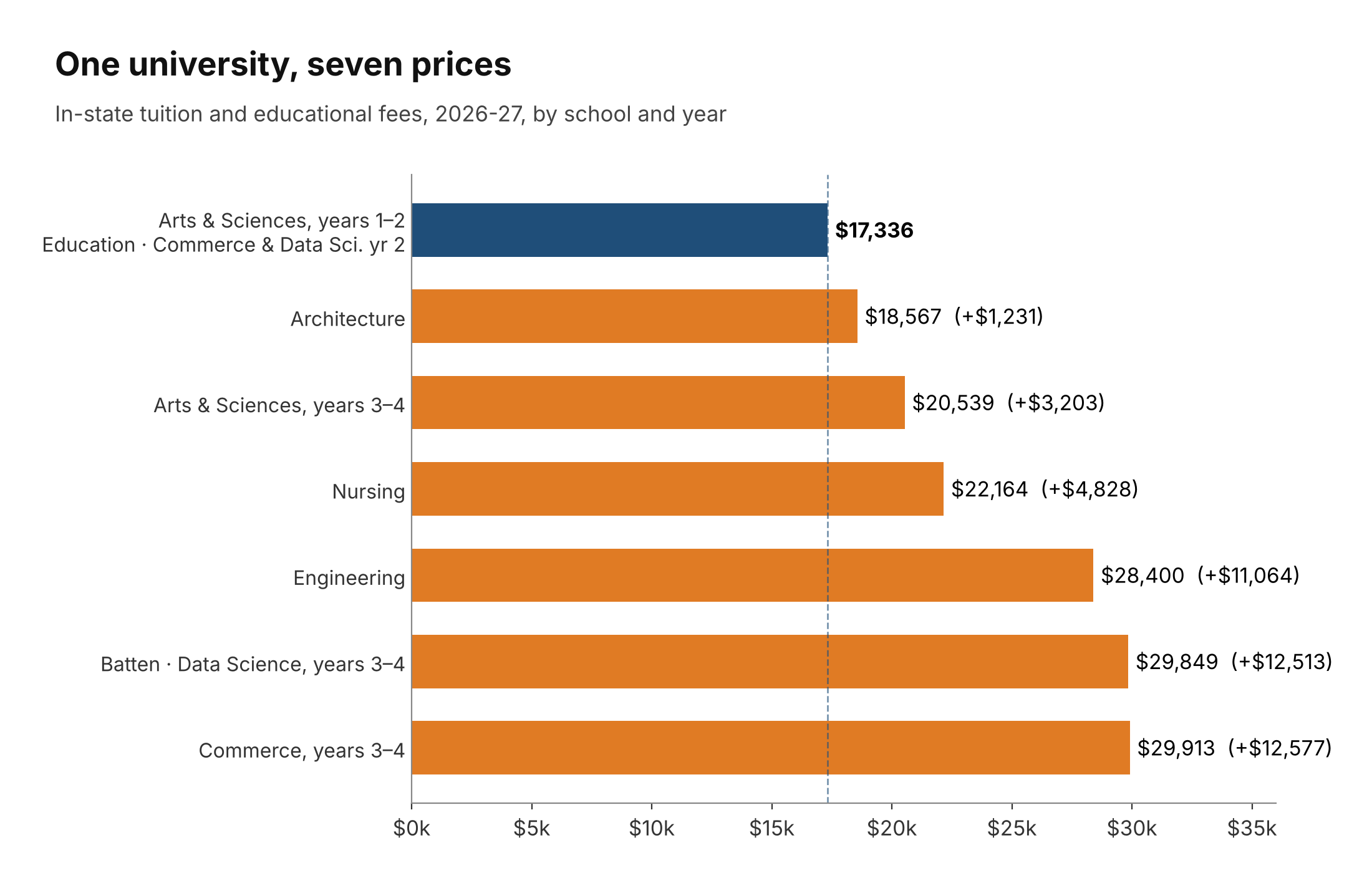
The top rate is $12,577 more than the bottom one, or about 72% higher. That extra amount is called a differential.
Over four years, at this year's prices and before any future increases, differentials add up:
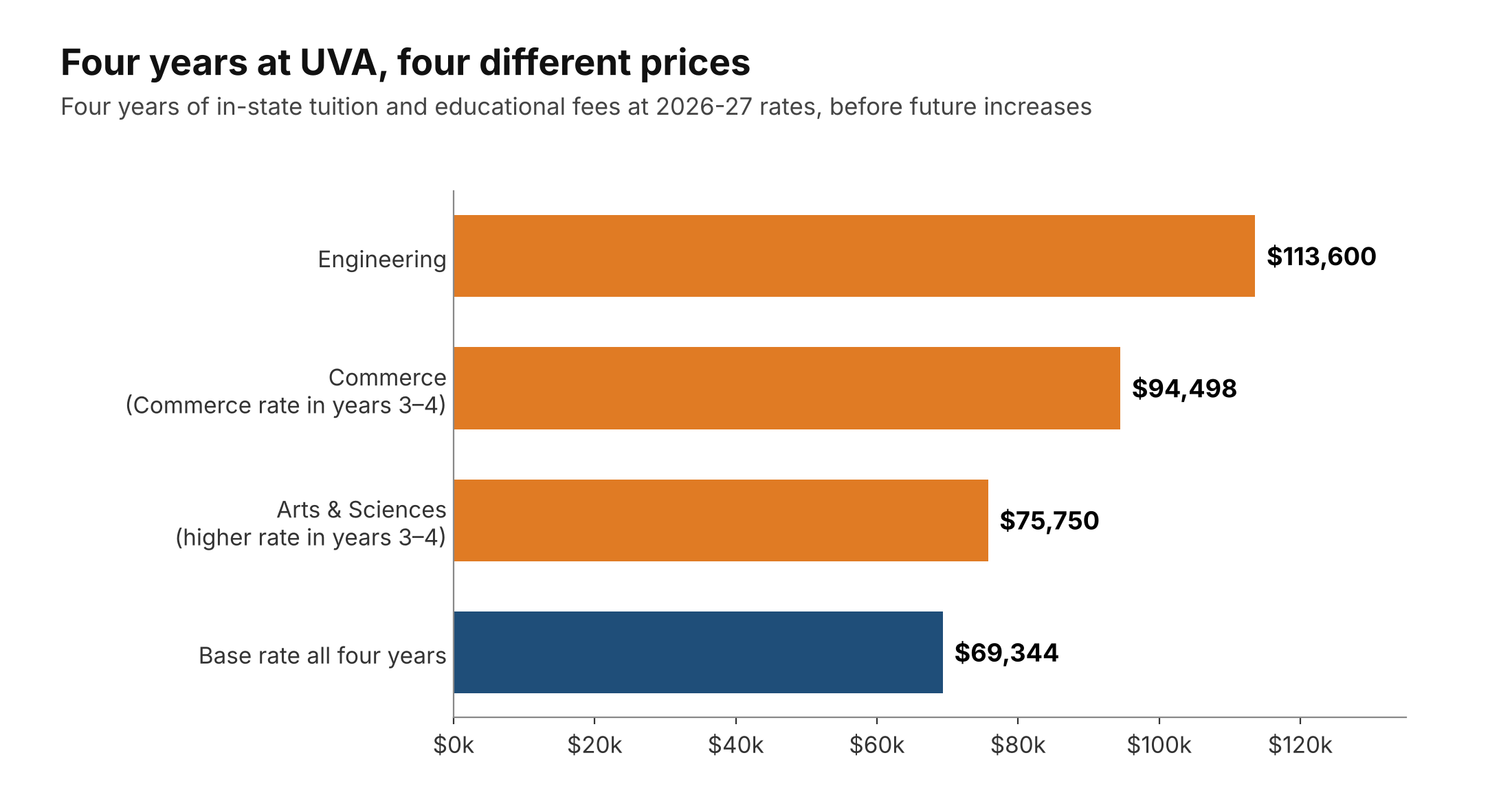
The Engineering degree costs about $44,000 more than the published price suggests.
Engineering students at least know their price going in, because they're admitted straight from high school. Commerce, Batten and Data Science aren't. Students start somewhere else at UVA, usually Arts & Sciences, and apply later: in the spring of first year for Commerce and Data Science, and in second year for Batten. The higher rate starts in third year, so a family can pay $17,336 for two years and then see the bill rise by about $12,500 a year:
- Commerce: from $17,336 to $29,913
- Batten: from $17,336 to $29,849
- Data Science: from $17,336 to $29,849
How it got this way
All this happened in the last 15 years. Until 2011, every Virginia undergraduate at UVA paid the same rate. In February 2011, the Board approved the first exception: an extra $3,000 for third-year Commerce students. Everyone else paid $9,684.
Over the next eight years, the Board added charges for Engineering, Batten, Nursing, Architecture and, finally, all third- and fourth-year Arts & Sciences students. The gap between UVA's lowest and highest rates grew quickly.
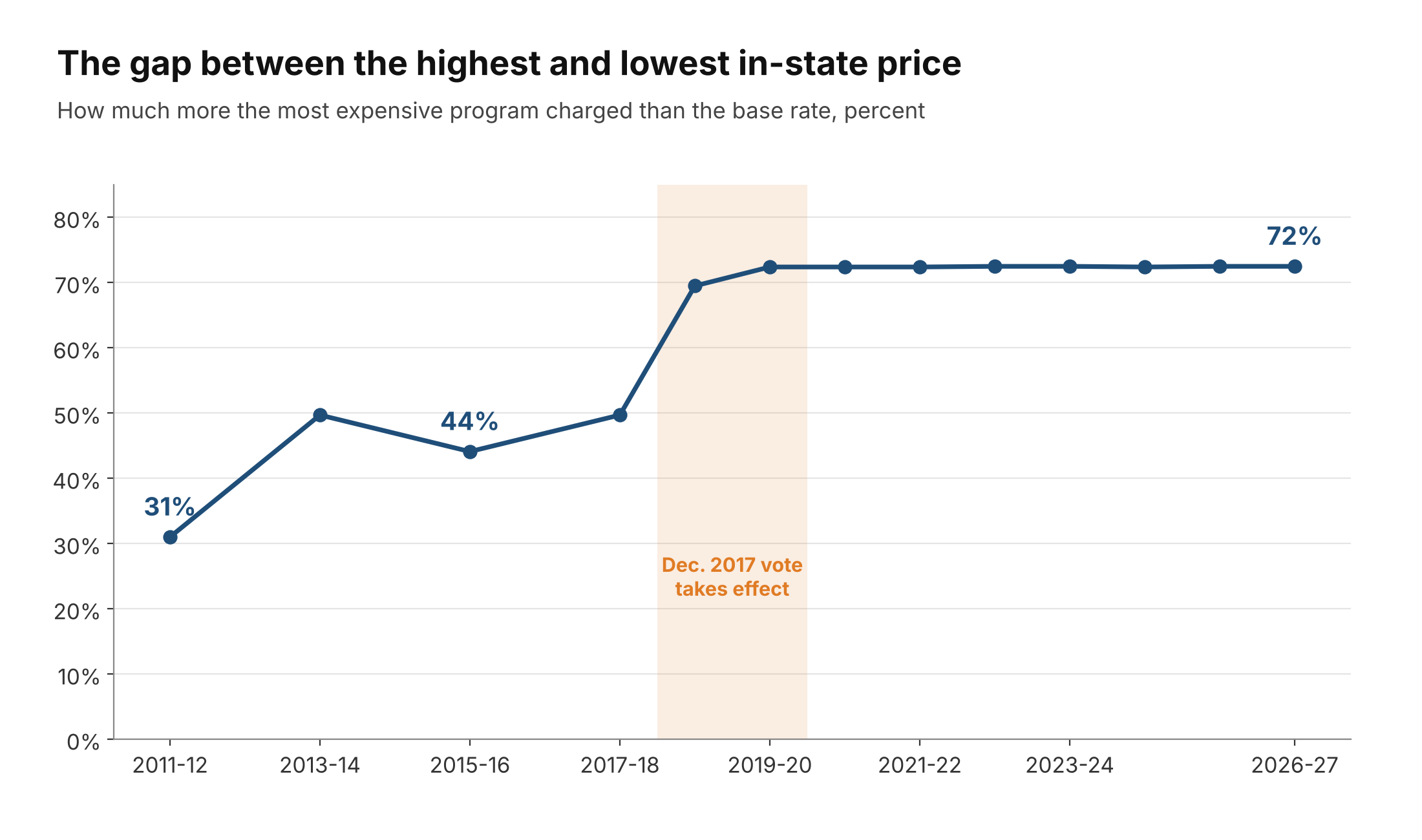
It has stayed at about 72% since, because the differentials now rise by the same percentage as the base rate each year.
In 2015 the Board went further. To pay for lower loan limits for students with financial need, it raised base tuition $1,000 for every Virginian entering that fall, and another $1,000 for the class after. Students already enrolled were exempt, so for a few years, Virginians sitting in the same classrooms paid three different base rates depending on when they arrived, and a fourth for families who paid extra to lock in their price. UVA's BOV materials described the next year's increase as 2.1% to 3.0%, but for the incoming class, it was 11%. (Note: In the chart above, the 2015-16 figure measures from the rate paid by students who entered before those steps.)
Because the rates are set together, one Board vote can raise tuition by very different amounts for different students. On Dec. 8, 2017, a single resolution set these increases for the following year:
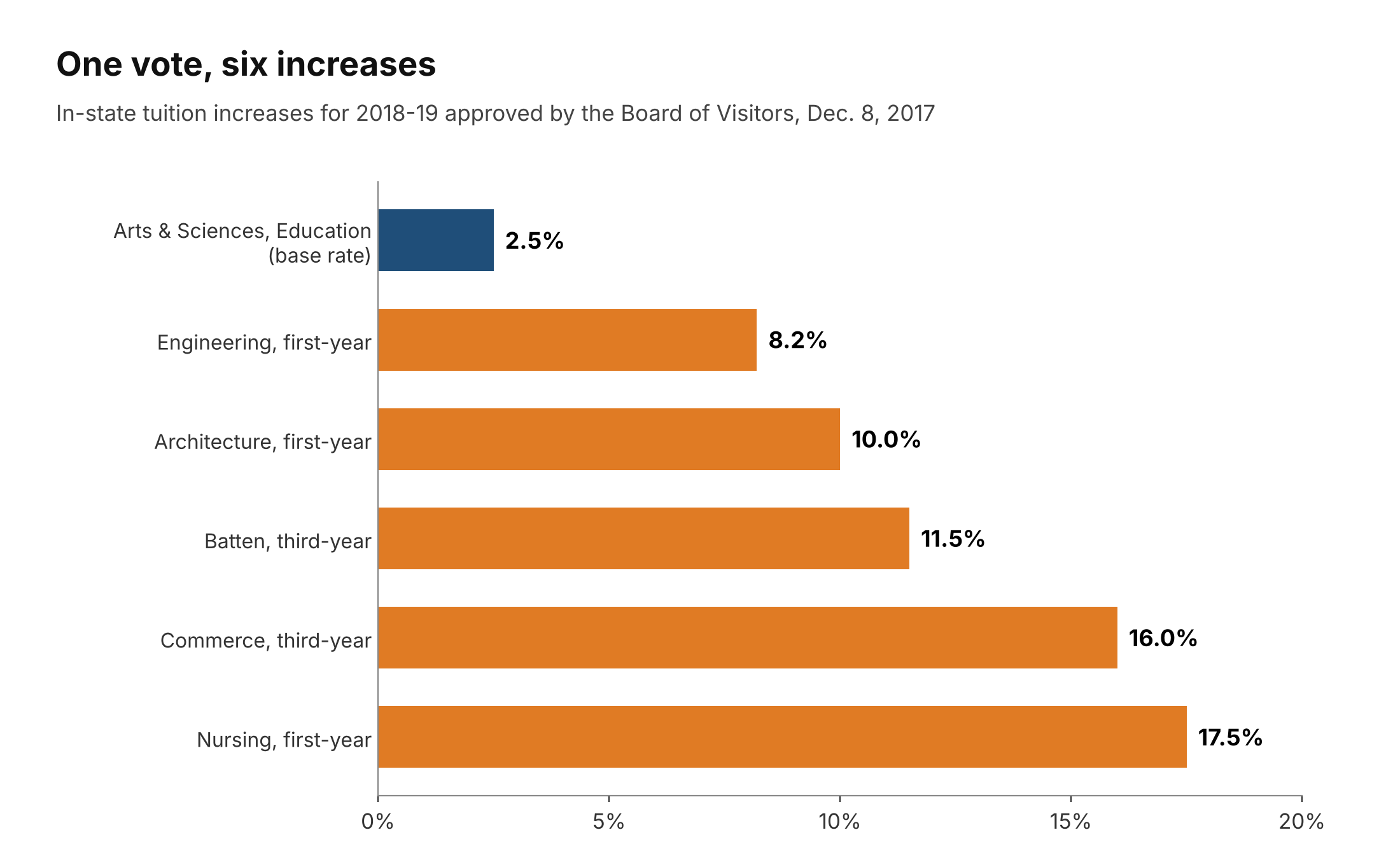
Yet what the public was told was 2.5%, the increase to the base rate. UVA's news release led with that number and said only that for students entering schools other than Arts & Sciences and Education, the new structure "adjusts tuition in varying amounts." It never said exactly how much, only noting a 3.3% weighted average. Some increases were as high as 17.5%.
That same vote also set an extra $1,000 for each new Engineering class through 2022, so every entering class paid more than the class ahead of it. Engineering didn't settle into a single rate for all years until 2025-26.
The last of those charges shows what this looks like from a family's side. In March 2019, the Board approved a higher rate for third- and fourth-year Arts & Sciences students, phased in so that no class already enrolled would pay it.
In the fall of 2020, UVA's admission office posted its brochure for students applying that year. The cost box was simple: tuition and fees for a Virginia student, $17,304.
Picture a Virginia family reading it at the kitchen table. Their daughter wants to study history. They decide UVA is within reach, and she enrolls in Arts & Sciences in the fall of 2021. For two years, the bill looks like what the brochure said. Then, in the fall of 2023, she starts her third year, and her tuition goes up about 22%, set way back in March 2019. That same year, UVA announced a 3% increase.
The higher rate had been on the books for more than a year before that brochure went online. It just wasn't in it.
The number everyone sees
That brochure wasn't entirely unusual. The state reports one number for UVA, too. The State Council of Higher Education for Virginia (SCHEV) lists a singular rate per university in its annual tuition report, a rate it says reflects what "the majority of full-time in-state undergraduate students" pay.
At most Virginia universities, the single rate is close to what almost everyone pays, because most schools don't have the extensive rate differentials UVA does.
But at UVA, that base rate leaves out every student in Engineering, Nursing, Architecture, Batten, Data Science and Commerce, and every Arts & Sciences student after second year.
The state number is the number reporters quote and state analysts use. It's also the number UVA puts in front of families. Every prospective-student brochure from 2020-21, 2021-22, 2022-23, 2023-24, and 2024-25 (the latest edition UVA still offers) prints one tuition figure. Each brochure lists Engineering, Commerce, Nursing and Batten among UVA's schools and notes that books, travel and loan fees vary. None says tuition varies.
In December 2021, the Board set 2022-23 rates under which Arts & Sciences students starting their third year saw their tuition rise 24%. The December 2021 news release reported "a 4.7% increase in base undergraduate tuition and fees for the 2022-23 academic year, and a 3.7% increase for the 2023-24 academic year." It cited rising operating costs, competitive faculty salaries and AccessUVA. President Jim Ryan said "these new tuition rates will help the University balance its annual budget in an inflationary environment, while maintaining our commitment to accessibility and to value."
The release never used the words "differential," "upper-division" or "third-year," and it didn't name a single school. Likewise, the 2022-23 brochure listed $18,236 in the same year third-year Arts & Sciences students saw their tuition rise 24%.
Is UVA the most expensive? How does it compare?
No, and also yes. On the state's numbers, no. SCHEV's standard comparison uses tuition plus all required fees (including student activity and athletics fees, which is why UVA's figure here is higher than the $17,336 above). For 2026-27:
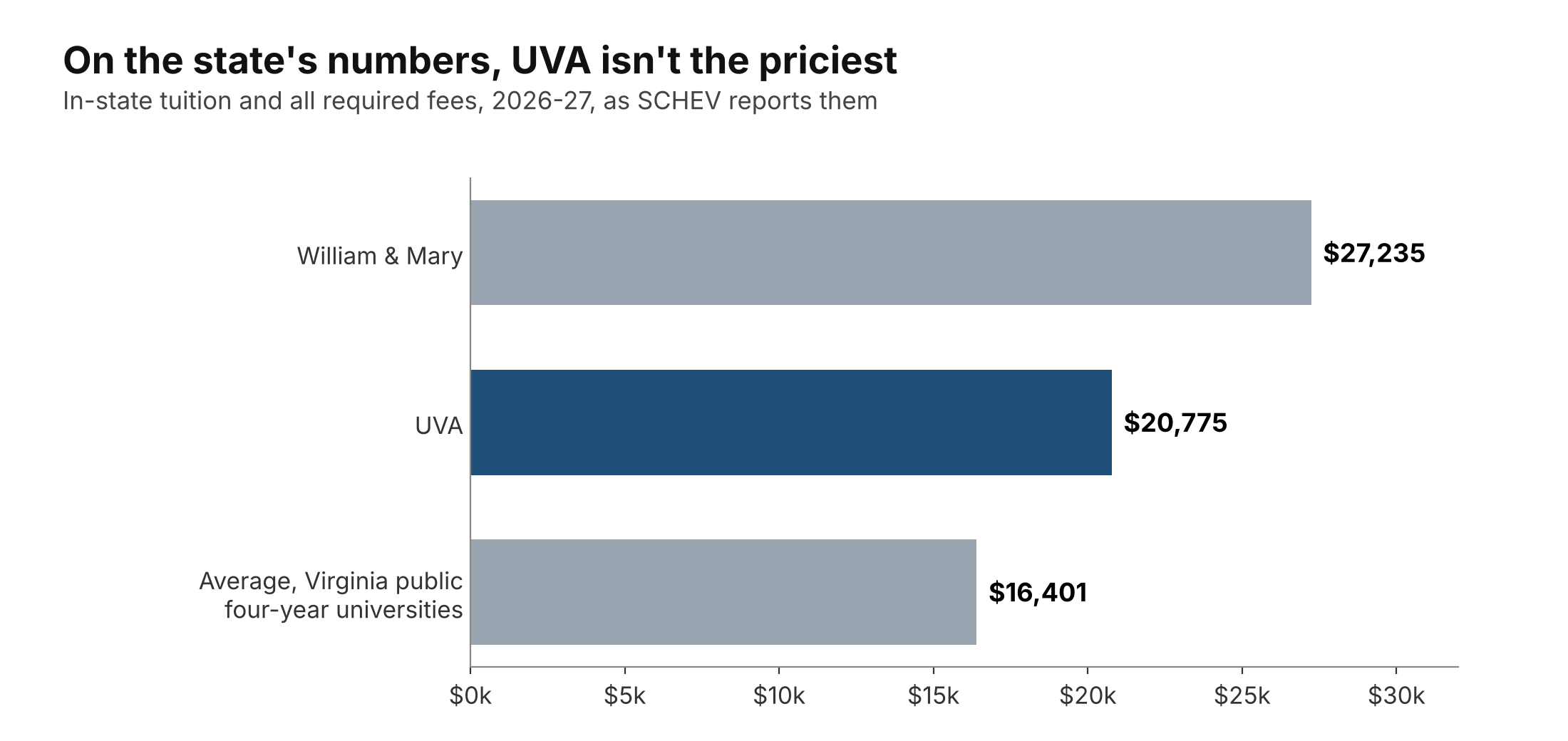
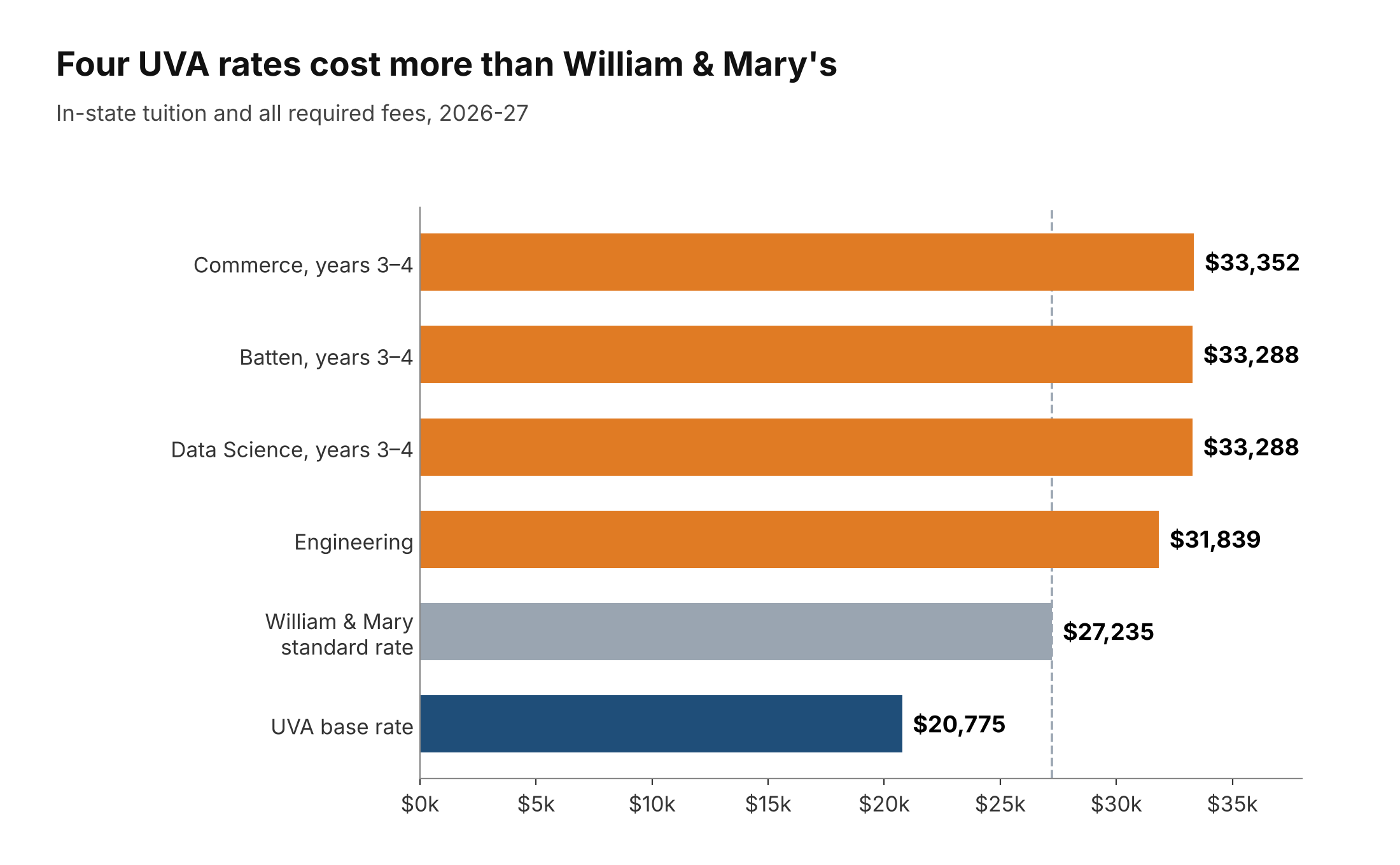
On paper, William & Mary costs about $6,500 more. But that compares William & Mary's standard price with UVA's lowest one. Put UVA's other rates on the same basis, and four of them cost more than William & Mary's standard price.
An in-state UVA Engineering student pays about $4,600 a year more than a William & Mary student paying the standard rate.
Doesn’t William & Mary have differentials too? Well, William & Mary does charge some students more, but it works differently. It adds $250 per credit hour for courses in certain programs, so a student pays it only by taking those courses. At UVA, the extra charge comes with a student's school and year — and course choices don't change it.
Other Virginia schools charge extra for some programs, too. SCHEV lists VCU, James Madison, and Virginia Tech. However, their tuition differentials are much smaller:
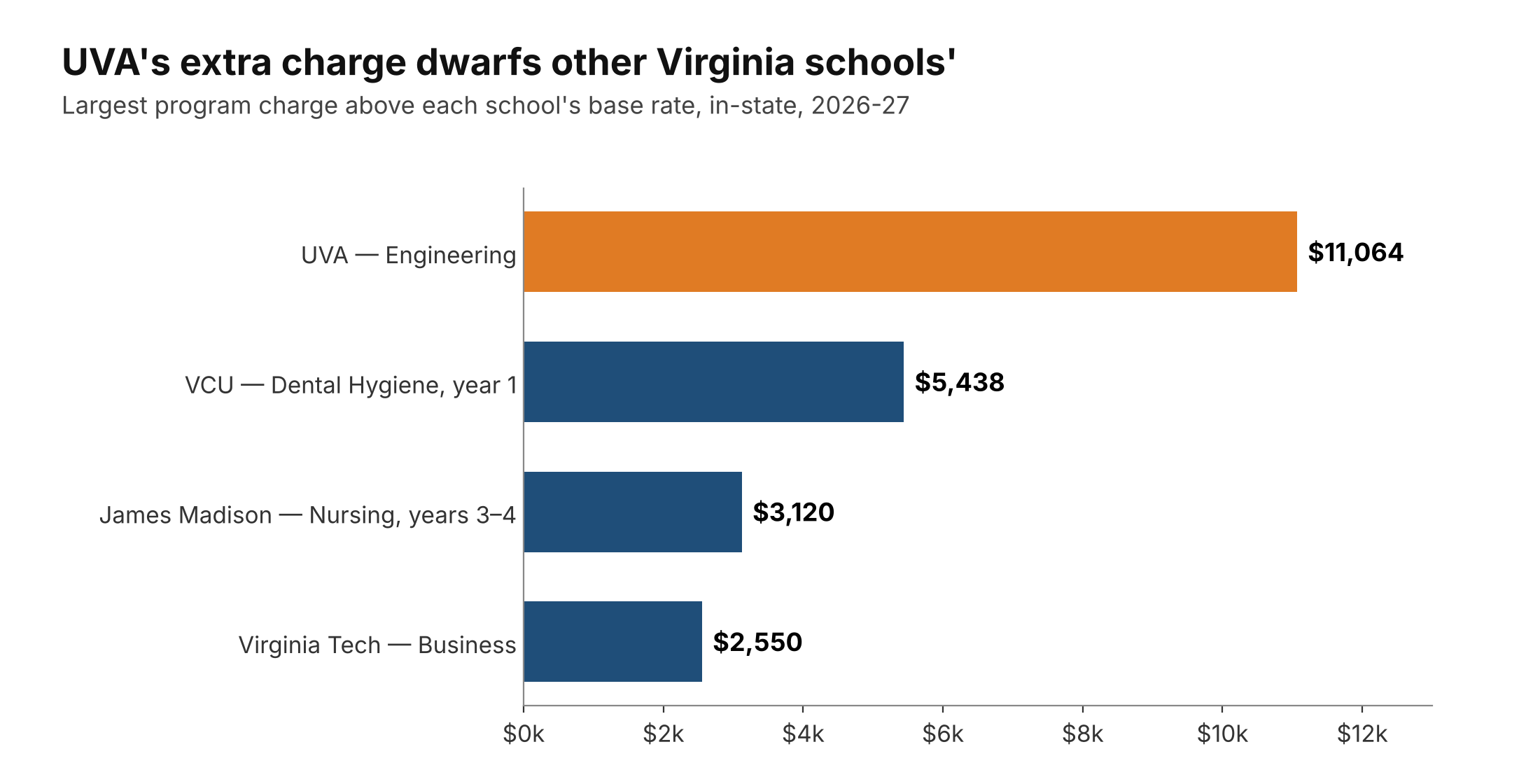
UVA's Engineering differential alone is about twice the largest differential at any other Virginia public university.
Compare engineering among schools, and the gap is wider: VCU charges its engineering students $2,120 more than its base rate, and Virginia Tech charges $2,000 more. UVA's extra charge is more than five times either one.
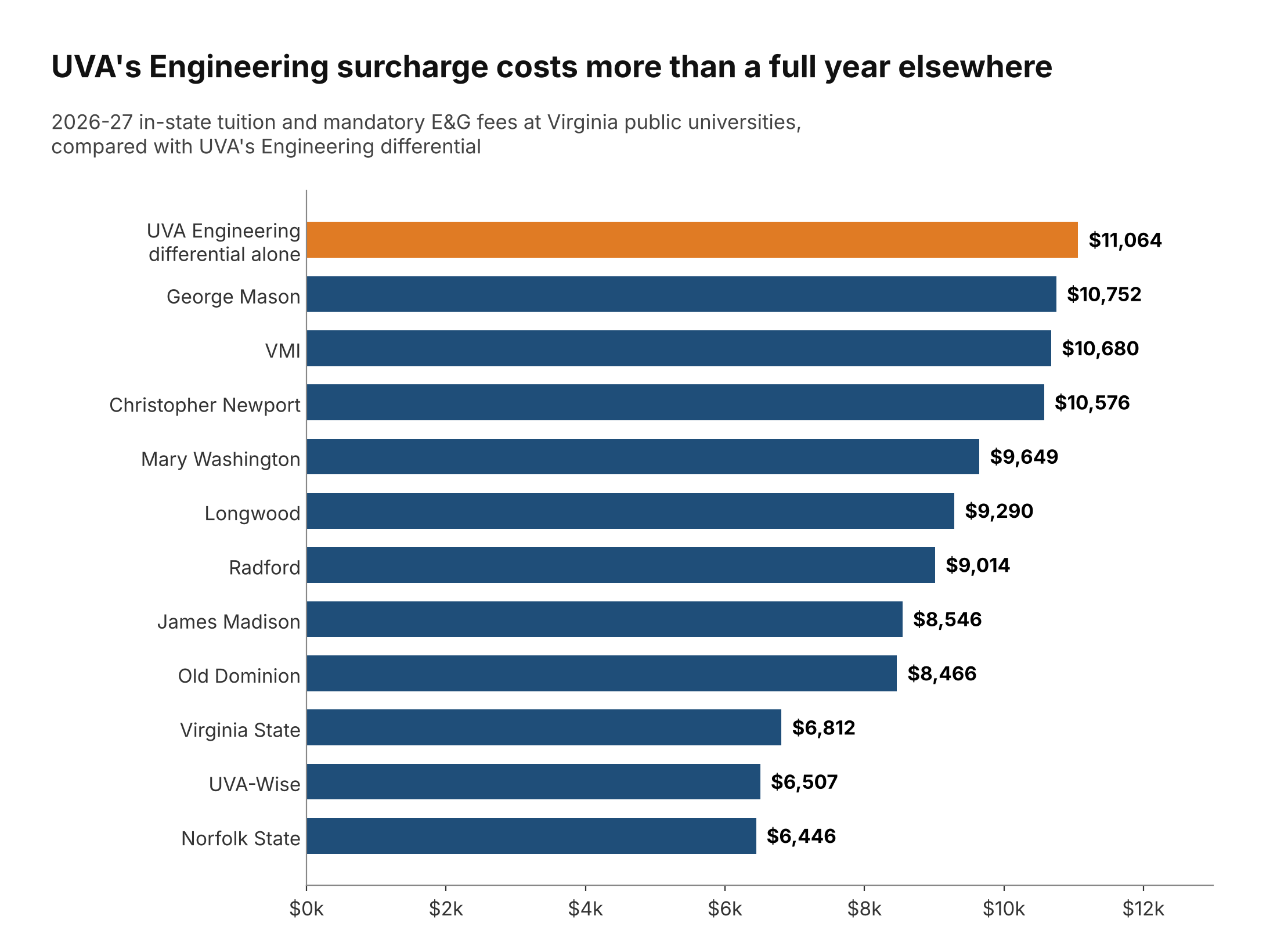
That’s not the worst of it. And UVA's extra charge alone is more than a full year’s tuition at most other Virginia universities.
You read that right. The $11,064 Engineering differential is more than the entire base tuition and E&G fees at George Mason, James Madison, Old Dominion and eight other Virginia public universities. And don’t forget that Batten ($12,513), Data Science ($12,513) and Commerce ($12,577) are even higher differentials than Engineering.
Back at the Kitchen Table
Now UVA can say with a straight face that its base tuition increases have averaged about 2.5% a year over the past seven years, and that the base rate has risen exactly as announced. That's true. But so is this: the base rate is UVA's lowest price, and it's the one UVA puts in its brochures and its public tuition announcements.
Go back to the two students from the same Virginia high school. SCHEV will report that they attend a university charging $17,336. One of them will pay that for two years, then more. The other will pay $11,064 more, every year. That's more than a full year of tuition and educational fees at 11 out of Virginia’s other 14 public universities.
How is that affordable?